
How to Learn the Pentatonic Scale Across the Guitar Neck
Most guitar players learn one pentatonic box and stay there for years. The real breakthrough comes when the five pentatonic positions stop feeling like separate diagrams and start feeling like one connected map. This guide shows you how to practice that connection so you can move around the fretboard with more freedom and less guesswork.
Why most players get stuck in one pentatonic box
The pentatonic scale is usually taught as a set of box patterns. That is useful in the beginning because it gives your hands a clear shape to work from. The problem is that many players stop there. They memorize one pattern, use it for a few licks, and never really learn how the rest of the neck connects to it.
That is why the fretboard can still feel random even after someone “knows” the pentatonic scale. They know one area. They do not yet understand how the notes continue beyond the edges of that box.
The goal is not to memorize five separate diagrams. The goal is to understand how all five positions overlap so you can move through the neck without losing the key center.
What “learning the pentatonic scale across the neck” actually means
Learning the pentatonic scale across the guitar neck means seeing each position as part of one larger system. Every shape contains notes that connect directly into the next shape above it and below it. Once you recognize those shared notes and shared root locations, the fretboard stops feeling like isolated islands.
In practical terms, this means three things:
- You can name the position you are in.
- You can find the root notes inside that position.
- You can move into the neighboring position without losing the sound of the key.
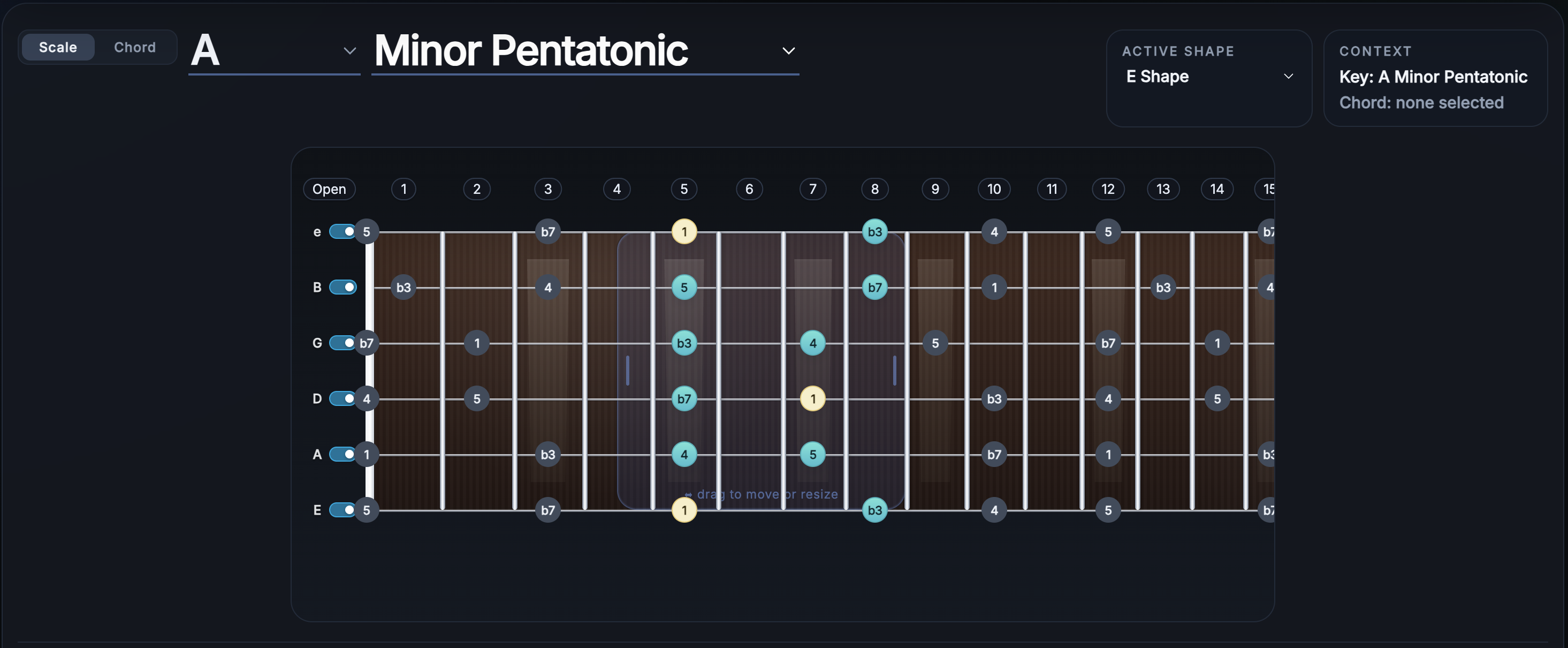
FretScope showing one minor pentatonic position in a single shape window, with root notes clearly labeled.
Start with one key and two connected positions
Do not try to master all five shapes at once. Pick one key and stay there long enough for the fretboard to start making visual sense. A good place to begin is a familiar minor pentatonic key such as A minor or B minor.
Start with one position. Play it slowly. Then move into the neighboring position and look for the notes both shapes share. The shared notes matter because they are the bridge between the two boxes. Once you can see that overlap, your brain starts to understand that these are not different scales. They are the same scale from different viewing angles.
A good first exercise
Ascend through one shape and descend through the next shape. Then reverse it. Keep your phrasing simple. The point is not speed. The point is to stop treating the shape boundary like a dead end.
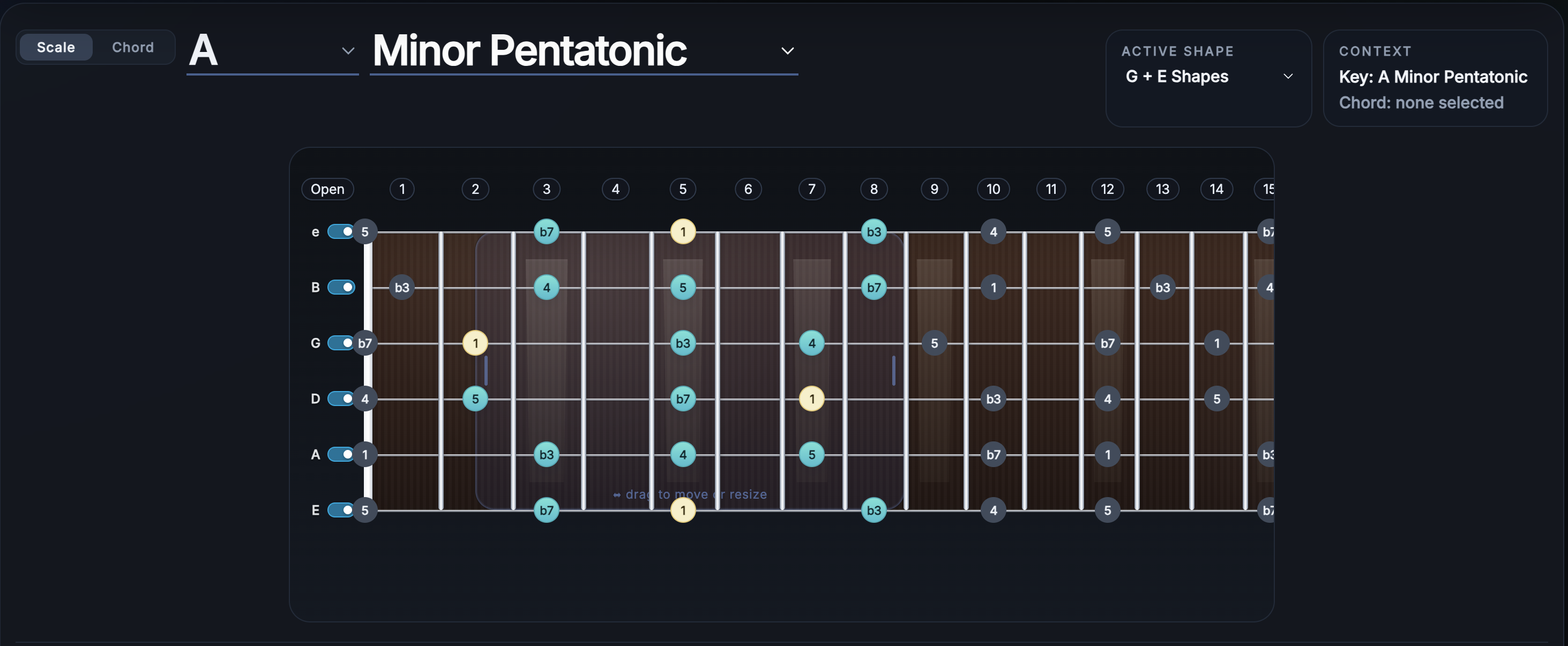
FretScope showing a two-position window with adjacent pentatonic shapes overlapping in one key.
Find the roots before you chase more patterns
If there is one habit that makes pentatonic practice more musical, it is learning to see the root notes quickly. Root notes tell you where the key lives inside the shape. Without them, a pattern is just finger movement. With them, the shape becomes usable.
Look for the roots on the 6th, 5th, and 4th strings first. Once those become easy to identify, the whole neck starts to organize itself. You no longer feel like you are floating inside anonymous dots. You know where “home” is.
If you only change one thing in your pentatonic practice, make it this: every time you learn a new shape, immediately locate the root notes inside it.
FretScope in scale mode with root-note labels highlighted inside a pentatonic position.
Use CAGED regions to make the positions easier to understand
Pentatonic positions become much easier to remember when they are connected to a chord shape region. This is one reason the CAGED system is so useful. It gives each part of the neck a visual anchor. Instead of thinking “random pentatonic box,” you start thinking “this scale region lives around this chord shape.”
That shift is powerful because scales and chords stop feeling like separate topics. The neck becomes more organized. You can see the shape, the roots, and the surrounding chord tones in one area instead of trying to memorize each concept separately.
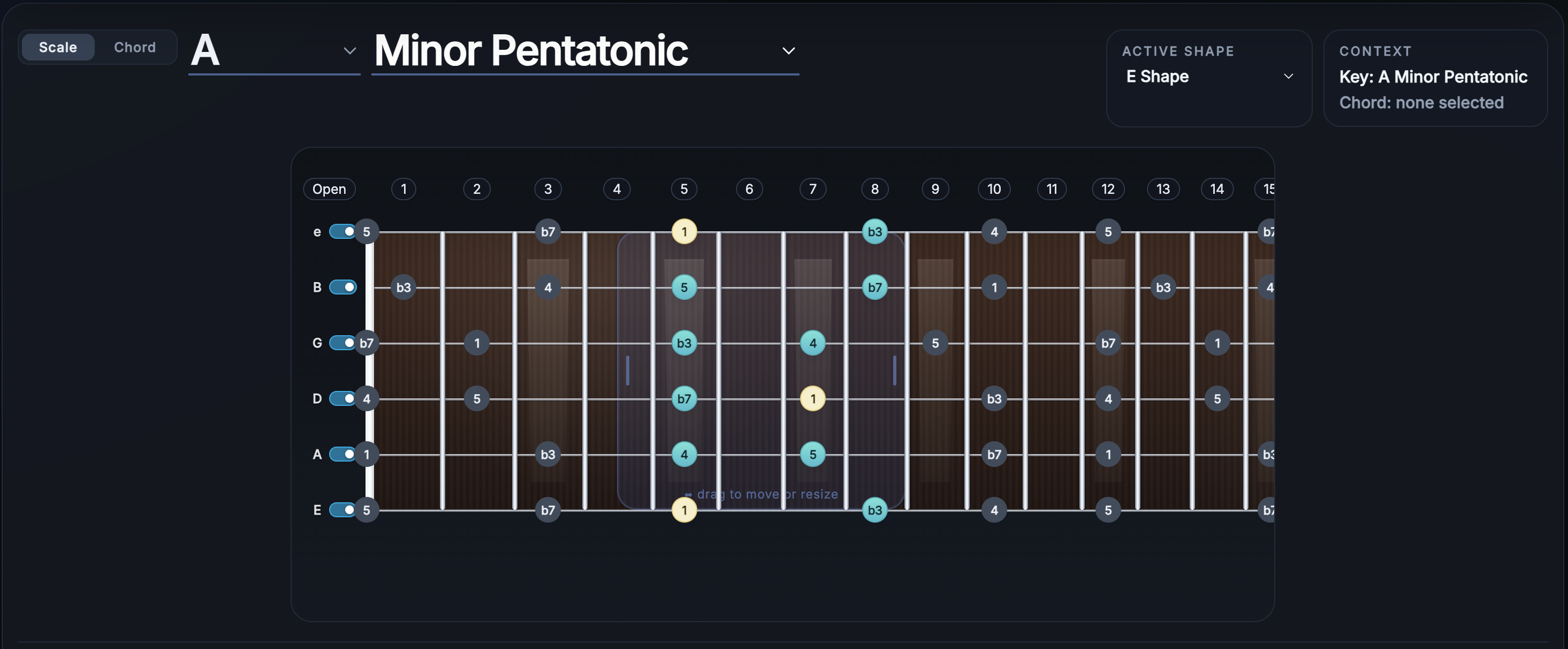
FretScope showing a pentatonic position with the matching CAGED region or active shape context visible.
How to practice pentatonic positions so they become usable in music
Many players can run a pentatonic pattern up and down, but that does not automatically help them make music. To turn scale knowledge into actual playing, practice with a little more context.
- Stay in one position and identify roots, thirds, and fifths.
- Move into a connected position without breaking the phrase.
- Play over a simple chord progression and notice which notes sound stable over each chord.
- Repeat the same idea in a different shape window.
This is where visual practice becomes especially useful. If you can see the neck and the active region at the same time, it becomes much easier to connect the shape to the sound.
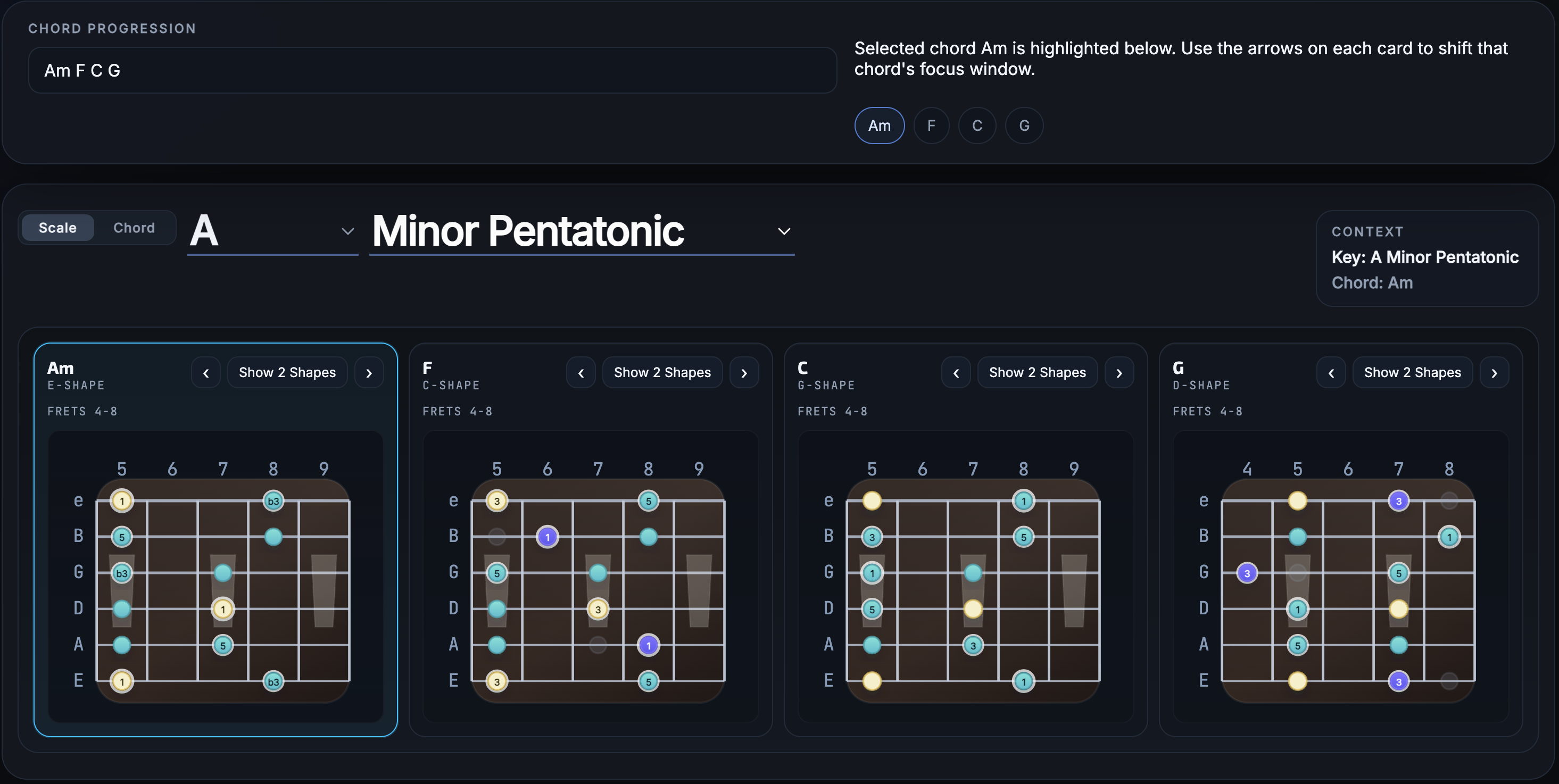
FretScope with a simple progression entered while staying in one pentatonic shape or region.
A simple way to think about all five pentatonic positions
You do not need to force yourself to memorize all five positions as separate facts. A more useful mindset is this: each position is just a connected region of the same scale. Learn how one region overlaps the next, and the whole map gets easier.
That is why moving between two neighboring shapes is often more valuable than trying to review all five in one session. Connection beats quantity. If your neck knowledge is connected, it becomes easier to use under real playing conditions.
Use FretScope to practice this visually
FretScope is built for exactly this kind of fretboard practice. You can choose a key, switch scale types, move between shape windows, highlight roots, and keep the neck visible while you explore how one pentatonic position hands off to the next.
Try this practice sequence in FretScope
Pick one minor pentatonic key, stay inside one shape, identify the roots, then expand into the neighboring shape and compare the overlap. Once that feels comfortable, add a simple progression and track which notes feel strongest over each chord.
Open FretScopeFrequently asked questions
Do I need to memorize all five pentatonic positions at once?
No. It is usually better to learn one position well, then connect it to the next one. That creates usable fretboard understanding instead of shallow memorization.
Should I learn major or minor pentatonic first?
Most players start with minor pentatonic because it shows up constantly in blues, rock, and lead guitar. Once that makes sense, it becomes easier to understand how the major pentatonic relates.
What is the fastest way to stop getting lost between shapes?
Learn the root notes inside each shape and practice moving between two connected positions in one key. That combination is usually more effective than memorizing more patterns.