
Blues Scale Guitar: Formula, Notes, and Fretboard Patterns
The blues scale is minor pentatonic with one extra note: the flat 5. That one note adds tension, grit, and movement, but it works best when you understand where it wants to resolve.
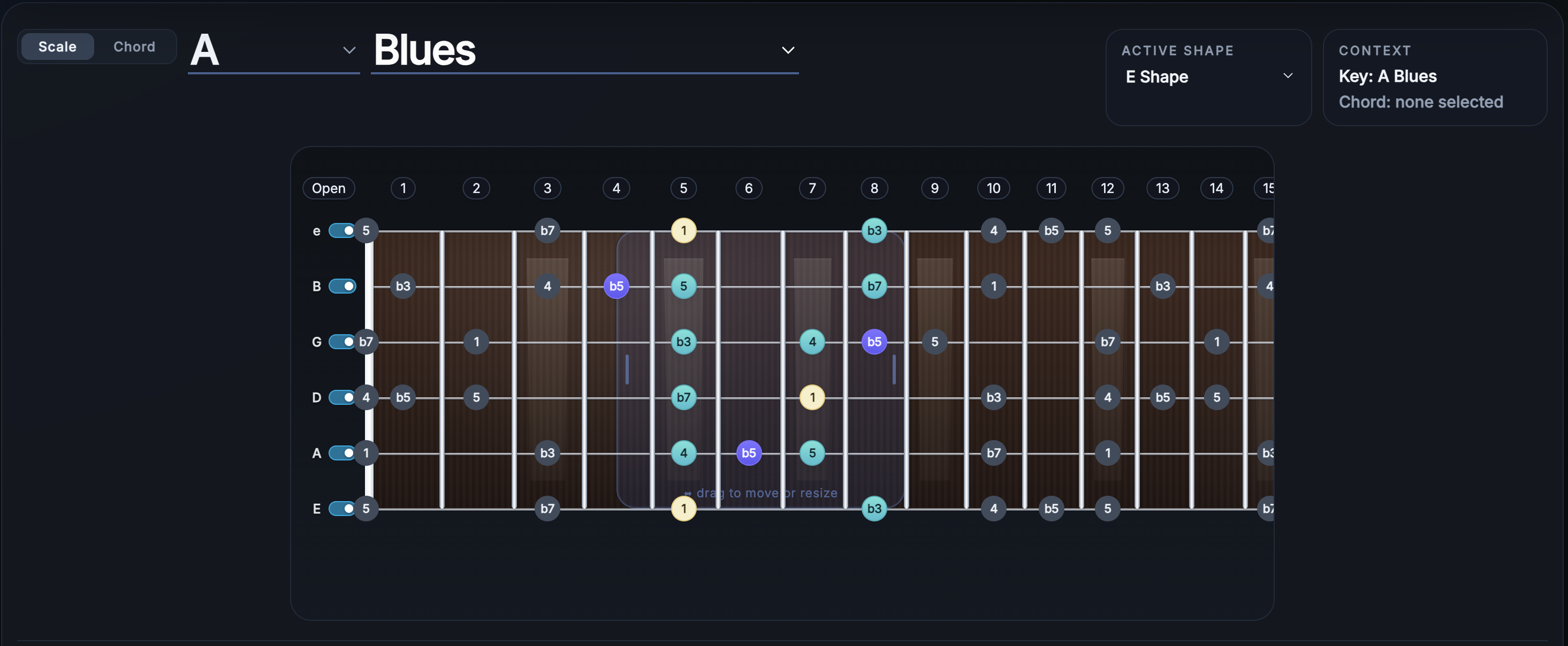
The blues scale formula
The minor blues scale formula is 1, b3, 4, b5, 5, b7. Compared to minor pentatonic, the only added note is b5.
In A blues, the notes are A, C, D, Eb, E, and G. The Eb is the blue note. It creates tension between the 4 and 5, which is why it sounds so good as a slide, bend, hammer-on, or passing tone.
Do not sit on the blue note forever
The flat 5 is powerful because it is unstable. If every phrase lands there, the sound gets sour quickly. A better approach is to pass through it on the way to the 4, 5, b3, or root.
Practice idea: play a minor pentatonic lick, then add the b5 only once. Listen to how much color one note can add.
Use the blues scale over dominant blues progressions
One reason the blues scale is so useful is that it can work over dominant 7 blues progressions even though it has a minor 3rd. That rub between major harmony and minor melody is part of the blues sound.
Try A blues scale over an A7-D7-E7 progression. Target the root and b7 for stability, then use the b3 and b5 for expression.
Related guides
Frequently asked questions
What notes are in the A blues scale?
The A blues scale contains A, C, D, Eb, E, and G.
Is the blues scale the same as minor pentatonic?
Almost. The blues scale is minor pentatonic plus the flat 5, often called the blue note.