
Guitar Fretboard Notes: How to Learn the Neck Without Getting Lost
Learning the notes on the guitar fretboard is easier when you stop treating the neck like 132 separate locations. The useful goal is to see repeatable landmarks: open strings, octave shapes, root notes, and scale regions.
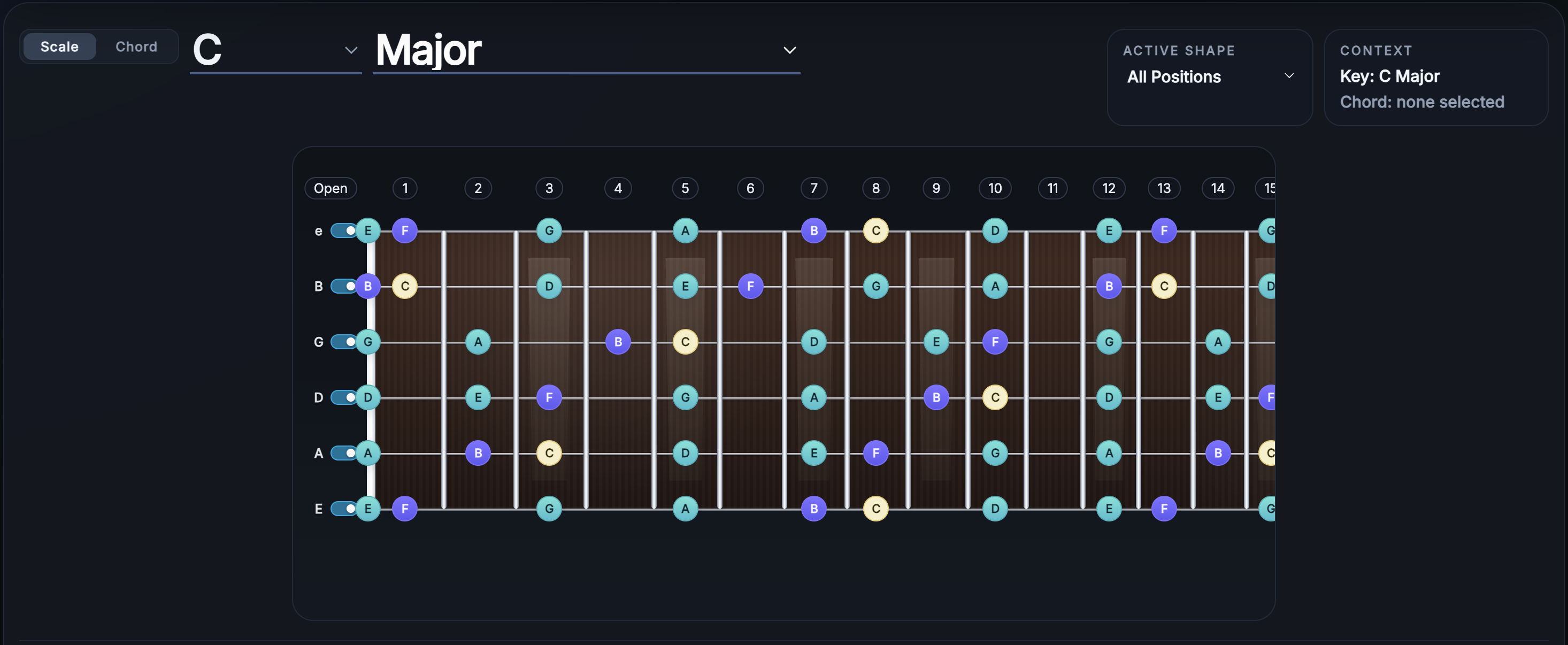
Start with the open strings
In standard tuning, the strings from low to high are E, A, D, G, B, and E. That is the first map. Every note you play on a string is counted upward from that open-string note.
You do not need to memorize the whole neck on day one. Start by making the open strings automatic, then learn where the natural notes fall on the low E and A strings. Those two strings become your address system for chords, scales, and CAGED shapes.
Use octave shapes instead of raw memorization
Octaves are the shortcut. If you know one C on the low E string, you can find another C two strings higher and two frets up. From the A string, the same shape works across to the G string. Across the B string, the shape shifts because the tuning changes.
Once you can see octave shapes, the fretboard becomes a network. A note is no longer one isolated dot. It is part of a repeating pattern.
Practice idea: pick one note, such as C. Find every C on the fretboard, then repeat with G, D, A, and E.
Learn root notes inside scales and chords
The most useful fretboard notes are often root notes. If you are practicing A minor pentatonic, find every A inside the shape before you worry about speed. If you are playing a CAGED chord, find the C notes that anchor the shape.
This gives note memorization a musical purpose. You are not naming notes as trivia. You are locating home base for the sound you are playing.
A simple practice path
- Name the open strings every time you pick up the guitar.
- Learn natural notes on the low E and A strings.
- Use octave shapes to copy those notes onto other strings.
- Choose one scale and find its root notes in every CAGED position.
- Use chord progressions to practice finding target notes in context.
Related guides
Frequently asked questions
Should I memorize every guitar fretboard note?
Eventually, yes, but not as random data. Learn open strings, octave shapes, and root notes first. Full-note recall gets much easier after that.
Which strings should I learn first?
Start with the low E and A strings because they anchor many barre chords, CAGED positions, and scale roots.