
Guitar Modes Explained: A Visual Guide for Players
Modes get confusing when they are taught as abstract parent-scale math. For guitar players, they become much clearer when you compare the notes that change the sound: Dorian's major 6, Mixolydian's b7, Lydian's #4, and so on.
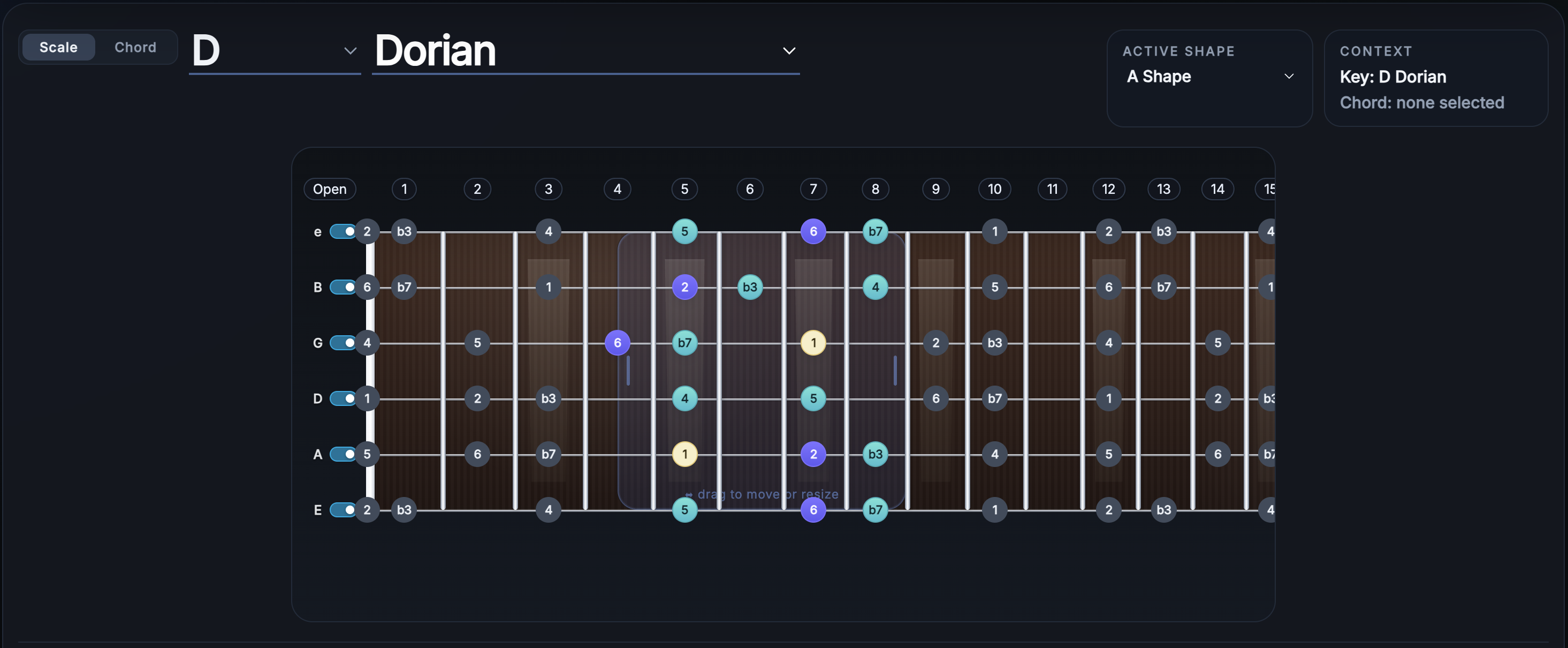
What modes are
A mode is a scale with its own tonal center and sound. The seven modes of the major scale are Ionian, Dorian, Phrygian, Lydian, Mixolydian, Aeolian, and Locrian.
The common explanation is that each mode starts on a different note of the major scale. That is true, but it is not the most useful way to play them. The useful question is: what note makes this mode sound different from major or minor?
The characteristic notes
- Ionian: major scale sound, 1 2 3 4 5 6 7.
- Dorian: minor with a major 6.
- Phrygian: minor with a flat 2.
- Lydian: major with a sharp 4.
- Mixolydian: major with a flat 7.
- Aeolian: natural minor sound.
- Locrian: diminished color with b2 and b5.
Practice modes against chords
Modes need harmony. D Dorian sounds like Dorian when D feels like home and the chord progression supports that sound. G Mixolydian sounds like Mixolydian when G7 or a dominant groove is the center.
Instead of running seven mode shapes in a row, pick one chord vamp and compare two sounds. Try A natural minor versus A Dorian. Then try G major versus G Mixolydian. Your ear will learn the difference faster than your eyes alone.
Related guides
Frequently asked questions
What mode should guitarists learn first?
Dorian and Mixolydian are usually the most practical first modes because they appear often in rock, blues, funk, and jam contexts.
Are modes just major scale patterns?
They can share notes with a parent major scale, but each mode needs its own tonal center. The sound comes from how the notes relate to that center.