
Major Scale Guitar: Notes, Formula, and Fretboard Patterns
The major scale is the source map for chords, keys, modes, and a huge amount of guitar theory. Once you can see it on the fretboard, other scale names stop feeling like disconnected vocabulary.
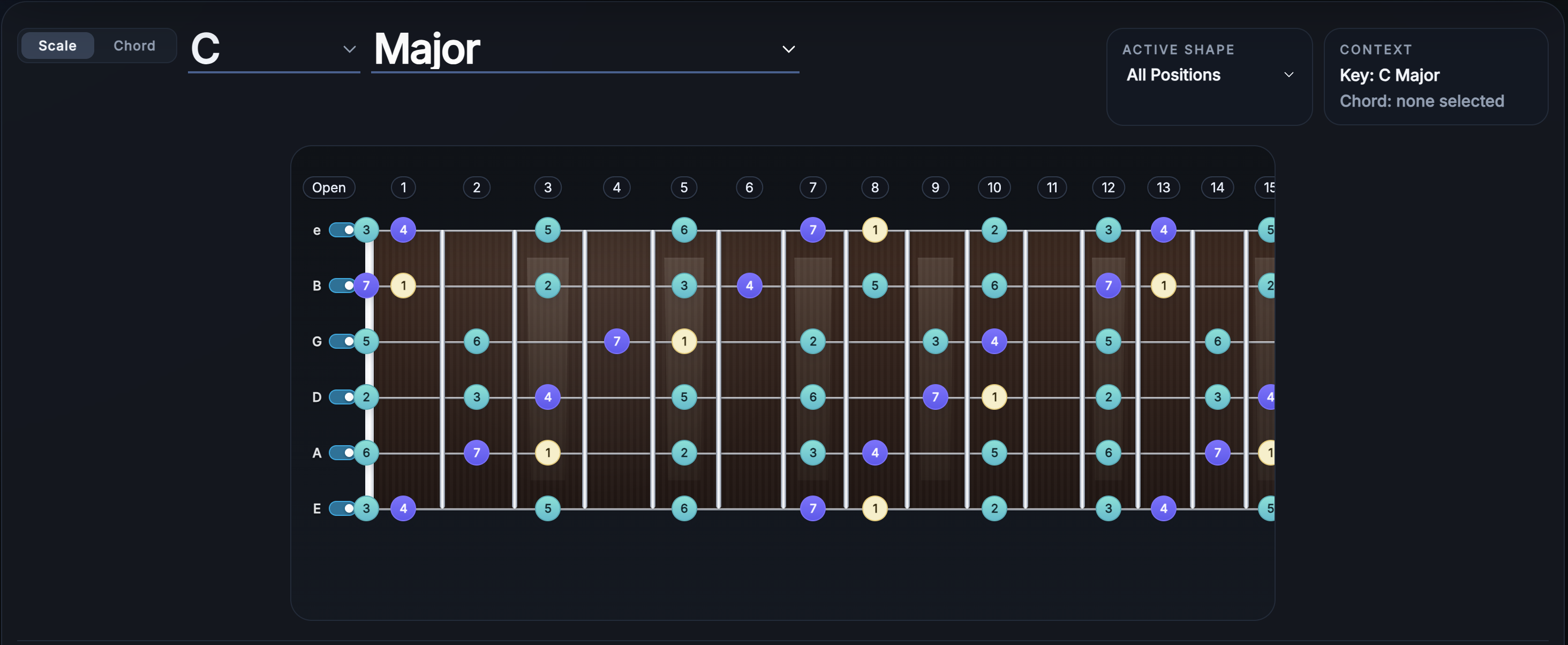
The major scale formula
The major scale formula is whole, whole, half, whole, whole, whole, half. In scale degrees, that gives you 1, 2, 3, 4, 5, 6, and 7.
In C major, the notes are C, D, E, F, G, A, and B. In G major, the same formula gives you G, A, B, C, D, E, and F#. The formula stays the same. The starting note changes.
Why guitar players should learn scale degrees
Note names matter, but scale degrees tell you what each note is doing. The 1 sounds like home. The 3 tells you major or minor. The 5 sounds stable. The 7 wants to resolve upward in a major key.
When you practice the major scale, say the degrees as you play. This makes chord construction and modes much easier later.
Connect the major scale to CAGED shapes
The major scale is easier to remember when each pattern sits around a chord shape. A CAGED region gives your hand a visual frame, and the scale notes fill in around that chord.
Pick one key, choose one CAGED position, and find the 1, 3, and 5 first. Then add the 2, 4, 6, and 7. This turns the scale from a fingering exercise into a map of the key.
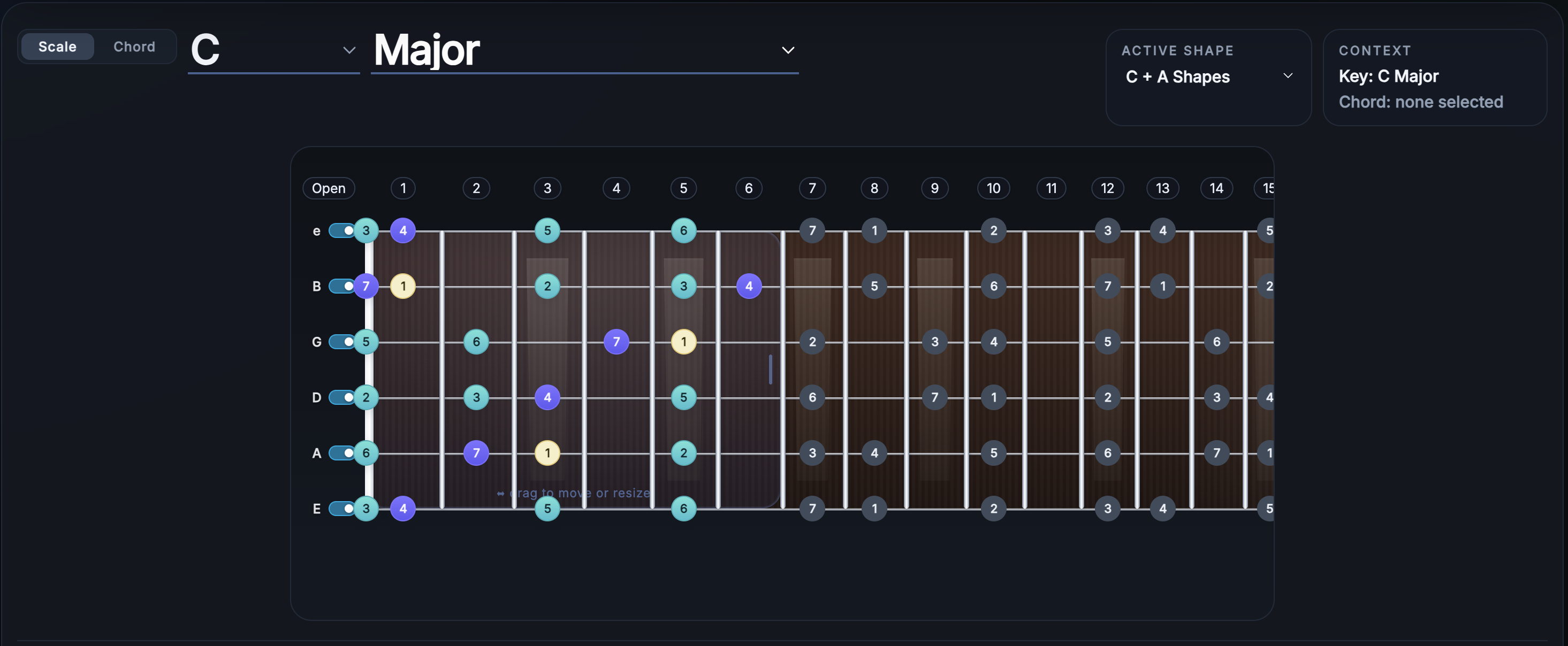
Practice sequence
- Play one major scale position slowly with degree labels in mind.
- Find the root notes in that position.
- Find the 3rd and 5th to see the major chord inside the scale.
- Move to the neighboring CAGED position and compare the overlap.
- Use a simple I-IV-V progression and target chord tones.
Related guides
Frequently asked questions
What is the C major scale on guitar?
The C major scale contains C, D, E, F, G, A, and B. On guitar, those notes repeat across the fretboard in multiple CAGED positions.
Should I learn the major scale before modes?
Yes. Modes are easiest to understand as variations or rotations of the major scale, especially when you can see the scale degrees.